The Ultimate Guide to Plastic Recycling Machinery: Transforming Waste into Wealth (2026 Edition)
In an era where sustainability is no longer a choice but a global mandate, the plastic recycling industry stands as one of the most lucrative and impactful sectors for entrepreneurs. Whether you are looking to start a small-scale social enterprise or a large-scale industrial plant, having the right Plastic Recycle Machine Set is the foundation of your success.
In this exhaustive guide, we explore everything from the mechanics of PET crushing to the profitability of pelletizing, and why Bhagwati Machinery Suppliers is the premier partner for your “Make in Nepal” industrial journey.
Chapter 1: The Global and Local Plastic Crisis
Understanding the Opportunity
Every year, millions of tons of plastic waste end up in landfills or oceans. However, in the eyes of a modern entrepreneur, this isn’t just waste—it’s raw material. The circular economy is booming, and plastic recycling is at the heart of it.
Why Start in Nepal?
With the increasing focus on local manufacturing and environmental conservation, setting up a recycling unit in regions like Butwal or Kathmandu offers:
-
Reduced Raw Material Costs: Waste plastic is abundant and cheap.
-
Government Incentives: Many regions offer tax breaks for eco-friendly businesses.
-
High Demand: Recycled granules are needed by industries ranging from textile to construction.
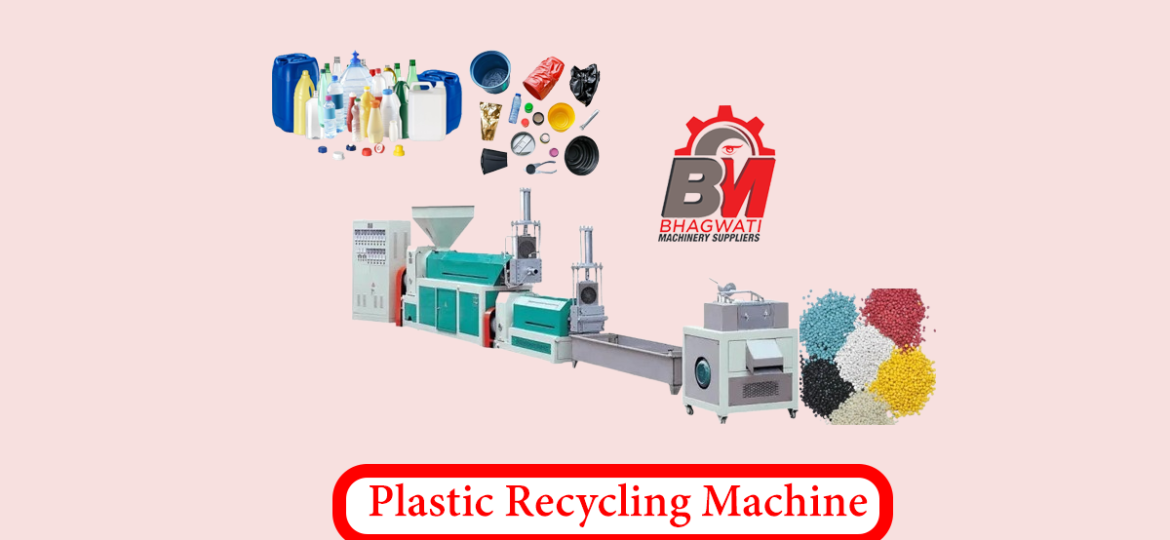
Chapter 2: Anatomy of a Complete Plastic Recycle Machine Set
A professional recycling setup isn’t just one machine; it’s a synchronized system. Here is the breakdown of the essential components:
1. The Plastic Crusher (Grinder)
This is the “entry point.” High-speed rotating blades break down bulky plastic items (bottles, crates, pipes) into small flakes.
-
Key Feature: Heavy-duty motor and wear-resistant blades.
2. Friction Washer and Floating Tank
Once crushed, the flakes must be cleaned.
-
Friction Washer: Removes dirt, sand, and glue.
-
Floating Tank: Uses density to separate different types of plastic (e.g., separating PET from PP/PE caps).
3. Plastic Dehydrator (Dryer)
Centrifugal force is used to remove moisture from the washed flakes. High-quality granules require bone-dry raw material to avoid bubbles during the melting process.
4. Plastic Pelleting/Granulator Line (The Extruder)
This is where the magic happens. The dry flakes are melted under controlled temperatures and forced through a die to create “spaghetti” strands, which are then cut into uniform pellets (granules).
-
Single Stage vs. Double Stage: For heavily contaminated plastic, a double-stage extruder ensures better filtration and purity.
Chapter 3: Technical Specifications & Customization
At Bhagwati Machinery Suppliers, we understand that no two businesses are the same. We offer machine sets ranging from:
-
Small Scale: 100-200 kg/hour (Ideal for startups).
-
Medium Scale: 300-500 kg/hour.
-
Industrial Scale: 1000+ kg/hour.
Power Consumption and Efficiency
Modern recycling machines are now built with energy-saving induction heaters and VFD (Variable Frequency Drive) systems to ensure that your electricity bill doesn’t eat into your profits.
Chapter 4: Business Model & Profitability
How to Make Money with Plastic Recycling
-
Selling Granules: Processing waste into high-quality PP or HD pellets to sell to plastic product manufacturers.
-
Product Manufacturing: Using your own recycled material to make items like plastic lumber, flower pots, or irrigation pipes.
-
Collection Hub: Charging municipalities or large corporations for waste management services.
ROI (Return on Investment)
Most well-managed recycling plants see a return on investment within 12 to 18 months, depending on the consistency of the raw material supply and the quality of the output.
Chapter 5: Operational Excellence & Maintenance
Running a machine set requires precision. This chapter covers:
-
Blade Sharpening: How often to maintain your crusher.
-
Temperature Control: Why 220°C might be perfect for PE but ruinous for other plastics.
-
Filter Changing: Utilizing hydraulic screen changers to keep production running without stops.
Chapter 6: Why Choose Bhagwati Machinery Suppliers?
We aren’t just selling machines; we are building industries. Our commitment to the “Make in Nepal” initiative ensures that you get local support, genuine spare parts, and expert consultation.
Connect With Us Across All Platforms
To see our machines in action, browse our catalogs, or get a personalized quote, use the links below:
-
🌐 Official Website: bhagwatimachinerysuppliers.com.np
-
🛍️ Hamro Bazar Profile: View our latest listings
-
🎥 YouTube Channel: Watch Machine Demos & Tutorials
-
📱 TikTok: Behind the Scenes & Quick Tips
-
👥 Facebook Page: Join our community
-
📍 Visit Our Warehouse: [suspicious link removed]
-
💼 LinkedIn: Professional Updates & B2B Networking
Chapter 7: Frequently Asked Questions (FAQs)
Q: Can one machine set recycle all types of plastic? A: While many machines are versatile, different plastics (like PVC vs. PET) have different melting points and chemical properties. We recommend specific setups for specific plastic streams to ensure the highest output quality.
Q: Do you provide training for the operators? A: Yes! When you purchase a full set from Bhagwati Machinery Suppliers, we provide installation support and technical training for your staff.
Q: What is the price of a full Plastic Recycle Machine Set? A: Prices vary based on capacity and automation levels. Contact us directly for a customized quotation.
Final Call to Action
The future of manufacturing is green. Are you ready to lead the change?
Contact us today for a consultation: 📞 WhatsApp: +977 9763651530 📍 Location: Butwal, Nepal